
How to Manage Multiple Cloud Kitchen Brands Under One Business
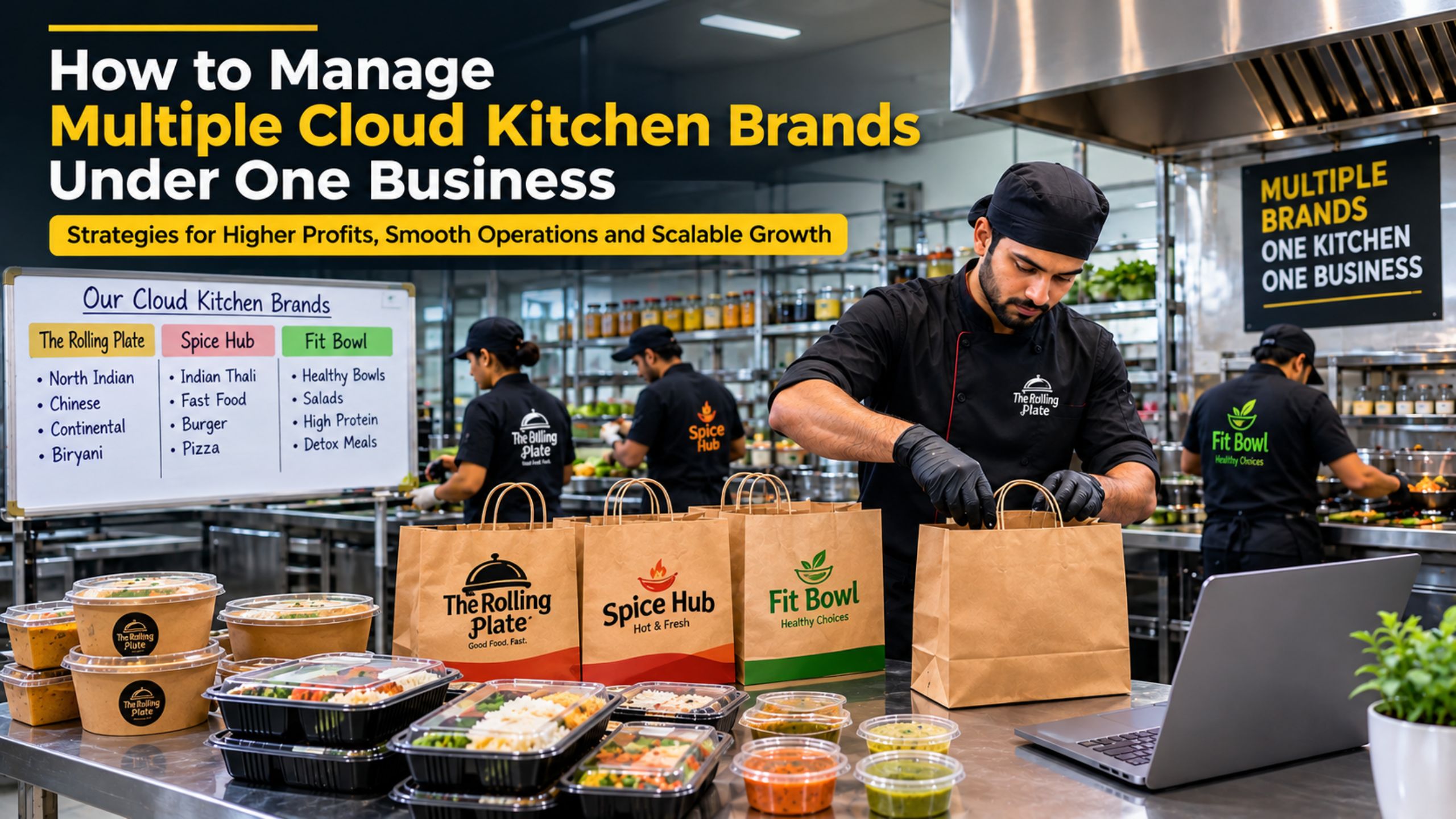
How to Manage Multiple Cloud Kitchen Brands Under One Business
Running one food brand from a cloud kitchen is already a busy job. Now imagine running two or three brands from the same kitchen, with different menus, packaging, customer groups, and delivery orders.
It may sound complicated, but a well-planned setup can make this model practical. A single kitchen can support different food concepts without needing a completely separate kitchen for every brand. This allows food entrepreneurs to test new ideas, serve different customer needs, and make better use of kitchen space, staff, equipment, and other resources.
The key is not simply adding more brands. The real challenge is building a system where every brand feels separate to the customer while the back end works as one organised operation.
This guide explains how to manage multiple cloud kitchen brands, from choosing food concepts and planning menus to controlling inventory, managing delivery orders, training staff, and scaling the business.
What Are Multiple Cloud Kitchen Brands?
Multiple cloud kitchen brands means operating two or more food brands from the same physical kitchen or business setup. Each brand can have its own name, menu, packaging, pricing, online listing, and target audience.
For example, one kitchen could operate:
| Brand | Food Concept | Main Customer |
| Brand A | Burgers and fries | Students and young customers |
| Brand B | Indian meals | Families and office workers |
| Brand C | Desserts and beverages | Snack and dessert buyers |
The customer sees three different food delivery brands, but the business can share the same kitchen, storage area, equipment, staff, and some ingredients.
This is one of the main ideas behind the cloud kitchen business model.
How Does the Multiple Brand Model Work?
The basic structure is simple:
One kitchen → multiple food concepts → separate online brands → shared back end operations
Each brand should have a clear identity. However, the kitchen team needs one central operating system.
For example, a customer ordering a burger should not know that the same kitchen also prepares Indian meals. From the customer’s point of view, they are ordering from a dedicated burger brand.
Behind the scenes, the same team may prepare both orders using shared equipment and ingredients.
This makes planning very important.
When Does Running Multiple Brands Make Sense?
Not every kitchen needs multiple brands. The model works best when the kitchen has enough demand, staff, equipment, and space to handle additional orders.
It can make sense when:
- You have unused kitchen capacity during certain hours.
- Your current kitchen has equipment that can support another concept.
- You want to test a new food idea without opening another location.
- Different customer groups are looking for different types of food.
- Some ingredients can be used across more than one menu.
- You already understand your delivery area and customer demand.
- Your team can follow separate recipes and preparation systems.
The important point is to add brands because there is a business reason, not simply because adding another name seems easy.
How to Choose Food Concepts for Multiple Brands
The first major decision is deciding what each brand will sell.
Avoid launching three brands that all sell almost the same food. Customers should have a reason to choose one brand over another.
A useful planning framework is:
| Factor | Brand 1 | Brand 2 | Brand 3 |
| Food category | Burgers | Indian meals | Desserts |
| Target audience | Students | Families | Young adults |
| Peak time | Evening | Lunch and dinner | Evening |
| Shared ingredients | Vegetables, sauces | Vegetables, spices | Dairy |
| Preparation style | Fast cooking | Batch cooking | Assembly |
| Main selling point | Quick meals | Complete meals | Sweet treats |
Before launching, ask:
- Who will buy this food?
- What problem or need does the brand address?
- Is there enough demand in the delivery area?
- Can the existing kitchen prepare it efficiently?
- Can the new brand use some existing resources?
- Is the menu simple enough to maintain quality?
A smaller menu is often easier to control than a large menu with too many ingredients and preparation steps.
How to Use One Kitchen for Multiple Brands Efficiently
A shared kitchen for multiple brands needs clear organisation.
You do not necessarily need separate kitchens for every brand, but you may need separate storage sections, preparation labels, recipe sheets, packaging areas, and order processes.
Create clear zones for:
- Raw material storage
- Vegetable preparation
- Meat or protein preparation
- Cooking
- Packing
- Finished orders
- Brand-specific packaging
Use labels and colour coding where helpful. Staff should be able to identify which ingredients and packaging belong to which brand quickly.
Good cloud kitchen operations aim to reduce confusion before it reaches the customer.
Keep Menus Simple and Connected
One of the easiest ways to create operational problems is to give every brand a huge menu.
Instead, look for ingredients that can be used in multiple dishes without making the brands feel identical.
For example, vegetables, sauces, cheese, bread, rice, or common spices may be useful across different concepts.
However, shared ingredients should not reduce brand quality.
Each brand should still have its own:
- Recipes
- Portion sizes
- Presentation
- Menu descriptions
- Pricing
- Packaging
- Customer experience
Create recipe cards with exact measurements and preparation instructions. This makes training easier and helps maintain consistency when different staff members prepare the same dish.
How to Manage Inventory Across Multiple Brands
Inventory becomes more complicated when several menus operate from one kitchen.
A good system should separate ingredients into three groups:
Common inventory: Ingredients used by several brands.
Brand-specific inventory: Ingredients needed only for one concept.
Packaging inventory: Boxes, bags, cups, labels, sauces, cutlery, and other packing materials.
Track daily usage and wastage. Do not simply purchase ingredients based on the total number of menu items.
For example, if three brands use onions, buy and store onions as common inventory. But if only one brand uses a special sauce, track that sauce separately.
This approach supports better cloud kitchen cost management and makes it easier to identify which brand is using more resources.
How to Manage Staff for Multiple Brands
Your kitchen team should know exactly which brand they are preparing an order for.
Assign responsibilities based on the kitchen workflow rather than creating unnecessary teams for every brand.
A simple structure could include:
- Kitchen manager
- Preparation staff
- Cooking staff
- Packing staff
- Order coordination staff
- Cleaning and support staff
During busy periods, staff can be assigned according to order volume.
For example, if Brand A receives 20 orders while Brand B receives only five, more staff can temporarily support Brand A.
Training is also important. Every employee should understand the recipes, portions, packaging, and quality standards for each brand they handle.
How Should Packaging and Orders Be Managed?
Order confusion is one of the biggest risks when operating multiple virtual restaurant brands.
A clear packing system can reduce mistakes.
Every order should show:
- Brand name
- Order number
- Customer items
- Special instructions
- Required packaging
- Add-ons
- Delivery platform
Keep packaging for different brands clearly separated.
A final order check before handover should confirm the food, quantity, sauces, drinks, packaging, and customer instructions.
A fast kitchen is useful only when the correct food reaches the customer.
Managing Delivery Platforms Across Multiple Brands
Each brand may have separate listings on food delivery platforms. This creates more menus, prices, promotions, ratings, reviews, and orders to monitor.
Use a central order management process wherever possible.
Your team should track:
- Incoming orders
- Preparation time
- Ready time
- Order cancellations
- Missing items
- Customer complaints
- Ratings
- Refunds
- Brand-wise sales
This is an important part of cloud kitchen management because a problem in one brand can quickly affect kitchen performance.
Build a Different Brand Identity for Each Concept
Multiple brands should not look like copies of each other.
Each one needs a clear identity through:
- Brand name
- Logo
- Menu design
- Food photography
- Packaging
- Tone of communication
- Offers
- Target audience
For example, a healthy meal brand should not use the same messaging as a late-night burger brand.
The kitchen can be shared. The customer experience should still feel intentional.
Create a Separate Marketing Strategy for Each Brand
A strong cloud kitchen marketing strategy starts with knowing who each brand is trying to reach.
Do not promote every brand with the same message.
For example:
Burger brand: Focus on quick meals, combos, and evening orders.
Meal brand: Focus on complete meals, lunch, family portions, and convenience.
Dessert brand: Focus on cravings, celebrations, add-ons, and evening snacks.
Track results separately. A promotion that works for one brand may not work for another.
Use Technology to Control the Operation
Technology can make multi-brand operations easier, especially as order volume increases.
Useful systems can help manage:
- Orders
- Inventory
- Recipes
- Sales
- Customer data
- Delivery status
- Staff tasks
- Product availability
- Brand-wise performance
The important thing is to create one source of operational information.
If staff members are checking different spreadsheets, messages, and devices for every brand, mistakes become more likely.
How to Control Costs Across Multiple Brands
One reason businesses consider this model is the possibility of sharing resources. But shared resources do not automatically mean lower costs.
Track costs separately for each brand.
| Cost Area | What to Track |
| Ingredients | Brand-wise food cost |
| Packaging | Cost per order |
| Staff | Hours and workload |
| Delivery | Platform charges and discounts |
| Marketing | Spend and sales generated |
| Utilities | Kitchen-wide usage |
| Wastage | Ingredients discarded |
| Refunds | Orders affected |
This helps answer an important question: Is each brand actually contributing to the business?
A brand with strong sales but very high food costs may need menu changes. Another brand with lower sales but better margins may have more potential.
Quality Control Is Non-Negotiable
When several brands share one kitchen, quality can become inconsistent if the operation grows too quickly.
Create standard checks for:
- Ingredient freshness
- Portion size
- Cooking time
- Food temperature
- Packaging
- Presentation
- Order accuracy
Use simple checklists during busy periods.
Managers should also review customer feedback regularly. Repeated complaints about the same dish, portion, packaging, or delivery issue should lead to an operational change.
Common Mistakes When Running Multiple Brands
Several mistakes can make the model difficult to manage.
Launching Too Many Brands at Once
Start with one additional concept and understand its performance before adding more.
Making Menus Too Large
More dishes mean more ingredients, training, preparation, and chances of wastage.
Mixing Brand Packaging
A customer should receive the brand they ordered from, not another brand’s packaging.
Ignoring Brand-Wise Costs
Total kitchen revenue does not tell you whether every brand is profitable.
Using the Same Marketing for Every Brand
Different audiences need different offers and messages.
Scaling Before the Kitchen Is Ready
If existing orders are already causing delays, adding another brand can increase the problem.
A Practical Example of Running Three Brands
Imagine a kitchen operating from 10 AM to midnight.
Brand A sells burgers and fries, with most orders between 6 PM and 11 PM.
Brand B sells Indian lunch and dinner meals, with strong demand between 12 PM and 3 PM and again during dinner.
Brand C sells desserts and drinks, with most orders after 7 PM.
The kitchen can use the same preparation area, refrigeration, cleaning team, and some common ingredients.
During lunch, more staff focus on Brand B. In the evening, cooking and packing capacity shifts toward Brand A and Brand C.
The business does not need three complete kitchens because the brands have different demand patterns.
However, this only works if recipes, inventory, staff responsibilities, packaging, and order tracking are clearly organised.
How to Scale Without Losing Consistency
Before launching another brand, check whether the current operation can handle more demand.
Review:
- Kitchen capacity
- Equipment usage
- Staff workload
- Ingredient storage
- Packaging space
- Delivery order volume
- Customer complaints
- Brand-wise margins
If one kitchen is already operating near its practical limit, adding another concept may create delays and quality problems.
Scale in stages. Test the concept, measure results, improve the operation, and then increase the menu or order volume.
FAQs
1. Can multiple brands operate from one cloud kitchen?
Yes. Multiple cloud kitchen brands can operate from one kitchen when the space, equipment, staff, storage, food safety processes, and local legal requirements are properly managed.
2. How many brands can one cloud kitchen manage?
There is no single number that works for every kitchen. Capacity depends on kitchen size, menu complexity, equipment, staff, order volume, storage, and peak hours. Two well-planned brands may be easier to manage than five poorly planned ones.
3. Do I need separate licenses for each cloud kitchen brand?
It depends on the business structure, location, food category, and applicable local rules. Do not assume that operating several brand names means every brand needs the same registration setup. Check the requirements that apply to your business before launch.
4. How do you manage inventory for multiple food brands?
Separate common ingredients, brand-specific ingredients, and packaging. Track usage and wastage by brand while keeping shared ingredients under a central inventory system.
5. Does operating multiple brands reduce cloud kitchen costs?
It can improve the use of shared resources, but lower costs are not guaranteed. The business still needs to track food cost, labour, packaging, platform charges, marketing, wastage, and other expenses for each brand.
6. How do you manage staff for multiple cloud kitchen brands?
Train staff on each brand’s recipes, portions, packaging, and quality standards. Use a central workflow and shift staff according to order demand rather than creating unnecessary teams for every brand.
7. How should different cloud kitchen brands be marketed?
Give each brand a clear audience and message. A burger brand, family meal brand, and dessert brand should not rely on the same offers or content. Track sales and marketing performance separately.
8. Can one kitchen use the same ingredients for different brands?
Yes, when the ingredients suit the recipes and quality standards of each brand. Shared ingredients can simplify purchasing and storage, but each brand should still maintain its own recipes and portion controls.
9. How can I prevent mistakes between multiple brands?
Use separate packaging, clear order labels, recipe cards, organised storage, and a final order checking process. Staff should always know which brand an order belongs to before preparation and packing.
10. Is The Rolling Plate suitable for businesses managing multiple food brands?
The Rolling Plate can be relevant to food entrepreneurs and operators seeking a structured approach to building and managing food brands from a shared kitchen setup. Businesses should still evaluate their menu, market, kitchen capacity, costs, and operational needs before adding a new brand.
Build More Brands Without Building More Kitchens
Managing several food brands from one kitchen is mainly an exercise in organisation. The strongest setup is not the one with the most brands. It is the one where every brand has a clear purpose, and the kitchen can consistently deliver each order.
Start with the right food concepts, keep menus practical, share resources carefully, separate brand identities, track costs, train staff, and use technology to keep orders and inventory organised.
If you are planning to build or manage multiple cloud kitchen brands, The Rolling Plate can help you think about the model from both the brand and kitchen operations side.
Contact us to discuss your cloud kitchen requirements and take the next step toward building a better organised multi-brand food business.

Enquire Now
Recent Post




Other Blogs
Discover our latest news
and updates now.
Cafe Franchise in India: Investment, Space, Fees & How to Start
October 19, 2026
KFC Franchise in India: Investment, Requirements & Franchise Process
October 04, 2026