

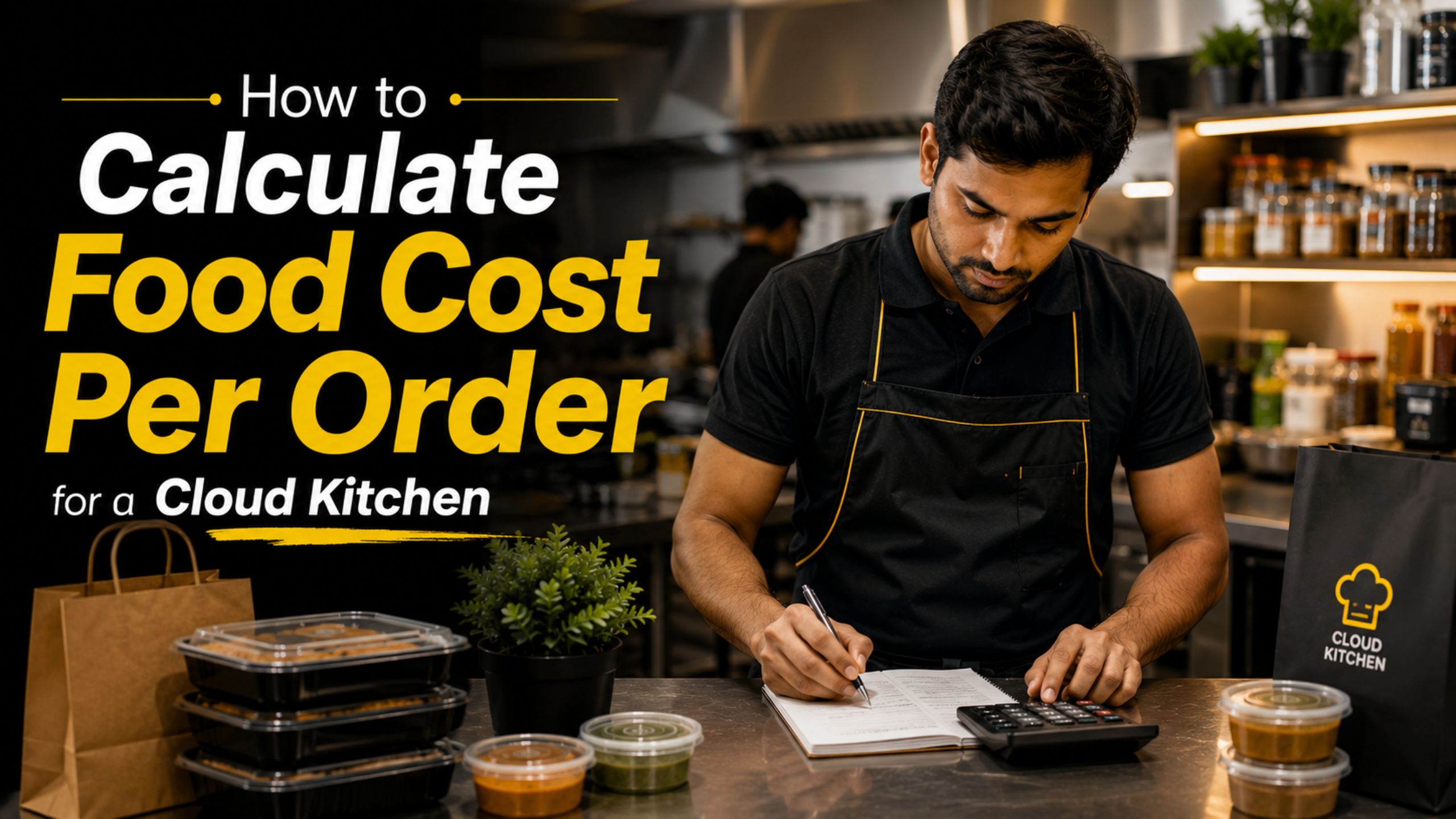
How to Calculate Food Cost Per Order for a Cloud Kitchen
How to Calculate Food Cost Per Order for a Cloud Kitchen
Running a cloud kitchen is not just about getting more orders. You also need to know how much money you actually spend on every order. A dish may sell for ₹250, but that does not mean you earn ₹250 from it. You first need to pay for ingredients, cooking items, packaging, sauces, wastage and, in some cases, delivery-related costs.
This is why food cost per order is one of the most useful numbers for a cloud kitchen owner.
When you know the real cost of preparing one order, you can set better menu prices, control portion sizes, reduce waste and find dishes that give you better returns. It also helps you understand whether your current prices are strong enough to support your cloud kitchen profitability.
For example, if a dish sells for ₹250 and its ingredients cost ₹110, you already know that ₹110 goes into preparing the food. Add ₹20 for packaging and your direct cost becomes ₹130. The remaining ₹120 still has to cover other business expenses before you can call anything your final profit.
The calculation is simple once you break it into small steps. This guide explains how to calculate food cost for a cloud kitchen, how to include wastage and packaging, how to calculate food cost percentage, and how to use these numbers when setting your menu prices.
What Is Food Cost Per Order?
Food cost per order is the amount spent on the ingredients required to prepare one portion of a menu item.
It can include:
- Main ingredients such as rice, vegetables, chicken or paneer
- Oil, butter and spices
- Sauces and chutneys
- Garnishes
- Complimentary food items
- A reasonable allowance for preparation waste
The basic food cost formula is:
Food Cost Per Order = Total Cost of Ingredients Used for One Order
For a more complete calculation, you can also calculate the total direct cost:
Total Direct Order Cost = Ingredient Cost + Wastage + Packaging + Other Direct Costs
Keeping ingredient cost and total direct cost separate is useful because it helps you understand exactly where your money is going.
Why Does Food Cost Matter for a Cloud Kitchen?
A cloud kitchen can have strong sales and still struggle to make a good profit if its menu prices and costs are not controlled.
Your cloud kitchen food cost helps you answer practical questions such as:
- How much does one dish really cost?
- Which dishes give the best return?
- Is my menu price too low?
- Are my portions too large?
- Am I wasting expensive ingredients?
- Is packaging costing too much?
- Can I offer discounts without hurting my margin?
For example:
| Menu Item | Selling Price | Ingredient Cost | Amount Left |
| Veg Rice Bowl | ₹200 | ₹65 | ₹135 |
| Chicken Rice Bowl | ₹250 | ₹110 | ₹140 |
| Paneer Wrap | ₹220 | ₹95 | ₹125 |
The amount left here is not the final profit. It still needs to cover packaging, delivery-related expenses, labour, rent, electricity, marketing and other costs.
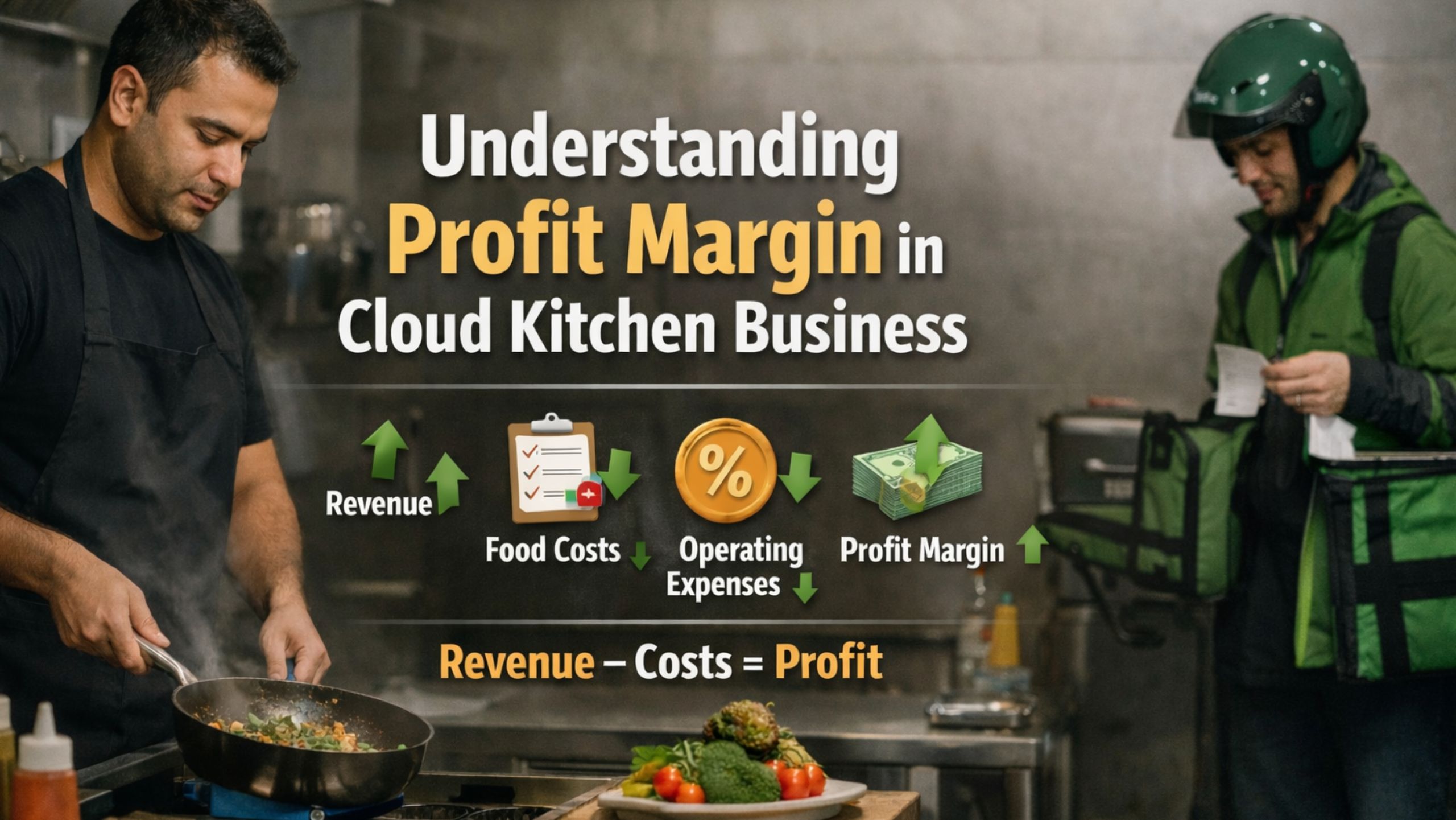
For a deeper look at the different expenses that affect the final return of a cloud kitchen, you can read Understanding Profit Margin in Cloud Kitchen Business.
Food Cost Per Order vs Total Operating Cost
One of the biggest mistakes new food business owners make is confusing food cost with total business cost.
Food cost per order mainly tells you what you spend to prepare the food. Your cloud kitchen operating cost includes every expense involved in running the business.
| Food or Direct Cost | Overall Operating Cost |
| Rice, vegetables, meat | Kitchen rent |
| Oil and spices | Staff salaries |
| Sauces and dips | Electricity and gas |
| Food packaging | Marketing |
| Food wastage | Equipment maintenance |
| Complimentary items | Software and other tools |
| Delivery cost paid by business | Licenses and other expenses |
Suppose your ingredients cost ₹100 and packaging costs ₹20. Your direct order cost is ₹120.
If the dish sells for ₹250, the remaining ₹130 cannot be called final profit because your other operating expenses still need to be paid.
For a broader understanding of costs that are often missed by new operators, see Boosting Cloud Kitchen Profitability: Hidden Costs and Planning Strategies.
How to Calculate Food Cost for a Cloud Kitchen
Step 1: Create a Standard Recipe
Start by writing down the exact recipe for every menu item.
Do not list only the main ingredients. Include oil, spices, sauces, garnish and other items used to prepare the dish.
For example, a chicken rice bowl may contain:
- 200 g cooked rice
- 120 g chicken
- 50 g vegetables
- Oil
- Spices
- Sauce
- Garnish
Also write the final portion size.
A standard recipe is important because you cannot calculate an accurate cost per order if every employee uses a different quantity.
Step 2: Calculate the Cost of Each Ingredient
Take the price you pay for an ingredient and calculate the cost of the quantity used in one order.
Suppose you buy 5 kg of rice for ₹300.
Cost per kg = ₹300 ÷ 5 = ₹60
If one order uses 200 g of rice:
Rice cost = ₹60 × 0.2 = ₹12
So, ₹12 is the rice cost for one order.
Repeat the same calculation for every ingredient.
Step 3: Calculate the Cost of the Actual Portion
Portion size can have a big effect on your food cost calculation.
Suppose your recipe says to use 120 g of chicken. If your staff regularly uses 150 g, you are giving customers an extra 30 g in every order.
The food may still taste great, but your cost is increasing.
Use a weighing scale, fixed scoop or standard serving tool where suitable. Train your kitchen team to follow the same portion size.
If you are also planning the menu around food cost and profitable dishes, Cloud Kitchen Menu Planning: High-Profit Food Ideas That Actually Sell can provide additional guidance on menu planning and pricing.
Step 4: Add Sauces and Complimentary Items
Small items are easy to forget when calculating the cost of ingredients.
Think about:
- Mayonnaise
- Ketchup
- Chutney
- Dips
- Lemon
- Herbs
- Garnishes
- Complimentary sauces
If one order receives two sauce cups, include the cost of both.
A small amount per order can become a meaningful expense when your order volume increases.
Step 5: Include Food Wastage
Wastage is part of the real cost of running a food business.
Common sources include:
- Spoiled vegetables
- Over preparation
- Incorrect orders
- Burnt food
- Poor storage
- Preparation waste
- Unsold prepared food
Keep a simple waste record. Write down what was wasted and why.
If the same ingredient is being thrown away regularly, you may need to change your purchasing quantity, storage method or preparation process.
This is also why food waste should be considered when working on food cost control.
Should Packaging Be Included in Food Cost?
Packaging is usually tracked separately from ingredient food cost, but it should be included when calculating the complete direct cost of a delivery order.
For example:
| Packaging Item | Cost |
| Food container | ₹8 |
| Lid | ₹2 |
| Sauce cup | ₹2 |
| Paper bag | ₹3 |
| Spoon and tissue | ₹2 |
| Sealing material | ₹1 |
| Total Packaging Cost | ₹18 |
If your ingredients cost ₹102 and packaging costs ₹18:
Total Direct Order Cost = ₹102 + ₹18 = ₹120
For a food delivery business, packaging is especially important because the customer receives the food in a container rather than on a plate.
If you want to understand packaging choices in more detail, The Rolling Plate also has a relevant guide on how to choose packaging for a cloud kitchen. Use the site’s packaging article as the internal link destination if that article URL is retained separately in your current site structure.
What About Delivery and Platform Costs?
Delivery charges and food delivery platform fees can also reduce the money you keep from an order.
However, it is better to track them separately instead of putting everything into basic ingredient food cost.
For example:
| Cost | Amount |
| Ingredient cost | ₹100 |
| Packaging | ₹20 |
| Delivery cost paid by business | ₹25 |
| Direct cost including delivery | ₹145 |
This gives you a clearer view of your actual order economics.
The important point is simple:
Ingredient food cost tells you what the food costs. Total order cost tells you what the sale costs you.
Step by Step Food Cost Per Order Example
Suppose you sell a chicken rice bowl for ₹250.
Here is a simple food cost calculator style example:
| Cost Item | Cost Per Order |
| Rice | ₹12 |
| Chicken | ₹55 |
| Vegetables | ₹15 |
| Oil and spices | ₹8 |
| Sauce and garnish | ₹7 |
| Wastage allowance | ₹5 |
| Total Ingredient Cost | ₹102 |
| Packaging | ₹18 |
| Total Direct Order Cost | ₹120 |
| Selling Price | ₹250 |
| Amount Left Before Other Expenses | ₹130 |
Now calculate each number:
Food Cost = ₹102
Total Direct Order Cost = ₹102 + ₹18 = ₹120
Amount Left = ₹250 − ₹120 = ₹130
The ₹130 is not your final business profit. You still have to account for expenses such as rent, salaries, electricity, marketing, platform fees and other operating costs.
How to Calculate Food Cost Percentage
Food cost percentage tells you how much of your selling price is being spent on ingredients.
The formula is:
Food Cost Percentage = Ingredient Cost ÷ Selling Price × 100
Using the example:
₹102 ÷ ₹250 × 100 = 40.8%
So, the food cost percentage is 40.8%.
If you want to calculate the percentage after adding packaging:
₹120 ÷ ₹250 × 100 = 48%
| Measure | Amount |
| Ingredient Cost | ₹102 |
| Selling Price | ₹250 |
| Food Cost Percentage | 40.8% |
| Packaging | ₹18 |
| Total Direct Cost | ₹120 |
| Direct Cost Percentage | 48% |
When comparing menu items, always use the same method. Otherwise, you may compare one dish using ingredient cost and another using ingredient plus packaging cost, which can give you the wrong picture.
How to Price a Cloud Kitchen Menu
Once you know your food cost, you can work on cloud kitchen pricing.
When deciding how to price cloud kitchen menu items, look at:
- Ingredient cost
- Wastage
- Packaging
- Delivery expenses paid by your business
- Platform and payment charges
- Labour
- Kitchen overhead
- Marketing
- Desired profit
Do not simply copy the price of another restaurant.
Two businesses can sell the same dish but have different supplier prices, rent, staff costs and packaging expenses.
Your price should cover your costs while still making sense to your customers.
How to Identify a Profitable Menu Item
A menu item should not be judged only by how many times it is ordered.
Create a simple costing sheet:
| Menu Item | Selling Price | Direct Cost | Amount Left |
| Veg Rice Bowl | ₹200 | ₹75 | ₹125 |
| Chicken Rice Bowl | ₹250 | ₹120 | ₹130 |
| Paneer Wrap | ₹220 | ₹95 | ₹125 |
| Chicken Wrap | ₹280 | ₹135 | ₹145 |
The last column shows the amount left after direct order costs. It is not your final net profit.
You can then compare this amount against your share of rent, staff, marketing and other operating expenses to understand your actual cloud kitchen profit margin.
Common Food Cost Calculation Mistakes
Forgetting Small Ingredients
Oil, spices, sauces and garnishes should not be ignored.
Ignoring Packaging
A delivery business needs containers, bags and other packaging.
Guessing Portion Sizes
Use a standard recipe instead of allowing every employee to decide the quantity.
Not Tracking Wastage
Regular waste increases your real cost of ingredients per order.
Treating Revenue as Profit
Sales are not the same as profit.
Using Old Ingredient Prices
If your supplier price changes, your old food cost sheet may no longer be accurate.
Giving Too Many Free Extras
Complimentary items have a cost too.
How to Reduce Food Cost Without Reducing Quality
You do not need to use cheaper ingredients to reduce food cost. Better control can make a big difference.
Standardise Portions
Use fixed weights and serving tools.
Track Waste
Record what is being wasted and identify the main reason.
Improve Storage
Store ingredients correctly and follow a proper stock rotation system.
Buy According to Demand
Avoid buying more fresh ingredients than your business can reasonably use.
Use Ingredients Across Multiple Dishes
If suitable ingredients can be used across several menu items, inventory management can become easier and waste may be lower.
Review Supplier Prices
Check supplier rates regularly while maintaining the quality you need.
Train Kitchen Staff
Everyone should follow the same recipe and portion size.
Review Your Menu
Remove or improve dishes that have high costs but do not generate enough value.
How Often Should You Review Food Cost?
Your food cost per order should be reviewed regularly.
Check your costing when:
- Ingredient prices change
- A recipe changes
- Portion size changes
- Packaging prices increase
- You add a new menu item
- Food wastage increases
- You change your selling price
- Your profit starts falling
For many small food businesses, a monthly review is a useful routine. If your ingredient prices change frequently, review the affected dishes sooner.
Keep a simple spreadsheet with:
| Ingredient | Purchase Price | Quantity Used | Cost Per Order |
| Rice | ₹60/kg | 200 g | ₹12 |
| Chicken | ₹250/kg | 220 g | ₹55 |
| Vegetables | ₹150/kg | 100 g | ₹15 |
| Oil and spices | ₹8 | Fixed quantity | ₹8 |
This works as a basic food cost calculator and can be updated whenever your supplier prices change.
If you are also managing more than one food brand from the same kitchen, How to Manage Multiple Cloud Kitchen Brands Under One Business is useful for understanding how shared kitchen operations can be managed.
Turn Every Order Into a More Profitable Sale
Understanding food cost per order gives you a much clearer picture of your business. Instead of guessing whether a dish is profitable, you can look at its actual ingredient cost, portion size, packaging, wastage and selling price.
Start with your top-selling dishes. Write down every ingredient, calculate the cost of the exact quantity used, add wastage and packaging, and then compare the result with your selling price.
Do this regularly, and you will have a better base for menu pricing, purchasing, portion control and food cost control.
The Rolling Plate also works with cloud kitchen and food business models, so owners and new entrepreneurs can use proper costing as one part of making better business decisions. If you want to know more about the opportunities or need help with your next step, Contact us.
Frequently Asked Questions
1. What is food cost per order in a cloud kitchen?
Food cost per order is the cost of the ingredients used to prepare one customer portion. For delivery businesses, you should also track packaging and other direct costs separately to understand the complete order cost.
2. How do I calculate food cost for a cloud kitchen?
List every ingredient used in one standard portion, calculate the cost of the exact quantity used, and add the cost of sauces, cooking ingredients and wastage. This gives you the ingredient food cost.
3. How do I calculate food cost percentage?
Use this formula:
Food Cost Percentage = Ingredient Cost ÷ Selling Price × 100
For example, ₹80 ingredient cost on a ₹200 selling price gives a 40% food cost percentage.
4. Should packaging be included in food cost?
It is better to keep packaging separate from ingredient food cost. However, include it when calculating your total direct order cost because packaging is a real expense for a delivery business.
5. Should food wastage be included in food cost?
Yes. Regular wastage increases the actual cost of producing food. Tracking waste helps you understand whether purchasing, storage or portion control needs improvement.
6. How do I know if my cloud kitchen menu price is profitable?
Compare your selling price with ingredient cost, packaging, delivery related costs, platform fees and your share of operating expenses. The amount left after these costs gives you a better idea of profitability.
7. What is the difference between food cost and operating cost?
Food cost mainly covers the ingredients used to prepare food. Operating cost includes the wider expenses of running the business, such as rent, salaries, electricity, marketing, maintenance and software.
8. How can I reduce food cost without lowering food quality?
Focus on standard portion sizes, better inventory control, proper storage, waste tracking, accurate recipes and smart purchasing. These methods can reduce unnecessary spending without lowering ingredient quality.
9. Can I use a food cost calculator for my cloud kitchen?
Yes. A spreadsheet can work as a simple food cost calculator. Record ingredient prices, recipe quantities, packaging costs, wastage, selling price and food cost percentage for each menu item.
10. Why should The Rolling Plate or a small cloud kitchen track food cost per order?
Tracking food cost per order helps a business understand what each sale actually costs. For The Rolling Plate and other cloud kitchen operators, accurate costing can support better pricing, portion control and overall business planning.

Enquire Now
Recent Post





Other Blogs
Discover our latest news
and updates now.
KFC Franchise in India: Investment, Requirements & Franchise Process
October 04, 2026

How to Make Money in the Food Industry
September 12, 2026