
Cloud Kitchen vs Restaurant: Which Is Better for Starting a Food Business?
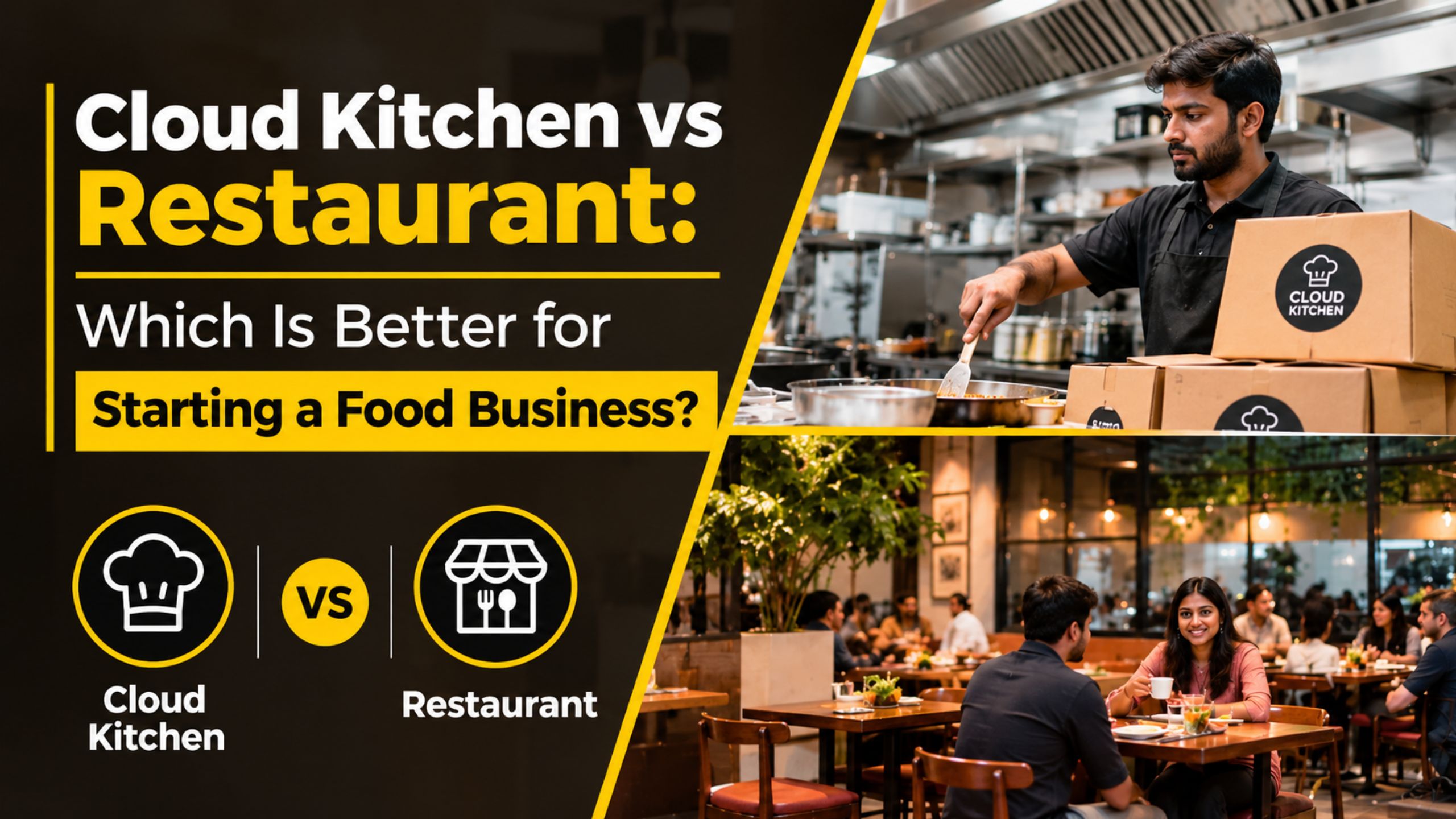
Cloud Kitchen vs Restaurant: Which Is Better for Starting a Food Business?
Choosing between a cloud kitchen and a traditional restaurant is one of the first major decisions for anyone planning to enter the food industry. Both models can attract regular customers and generate revenue, but they work in different ways.
A cloud kitchen focuses on preparing food for delivery and takeaway without a customer dining area. A traditional restaurant serves customers at the outlet and may also accept takeaway and online orders.
For people with limited capital, a cloud kitchen may be easier to start because it does not require dining space, furniture or expensive interiors. A restaurant may be a better choice if the food concept depends on customer experience, seating, walk-in traffic and direct interaction.
This guide explains Cloud Kitchen vs Restaurant in terms of investment, monthly expenses, profitability, location, staffing and business growth so you can choose a model that fits your plans.
What Is the Difference Between a Cloud Kitchen and a Restaurant?
The main difference between cloud kitchen and restaurant is the customer experience and order process.
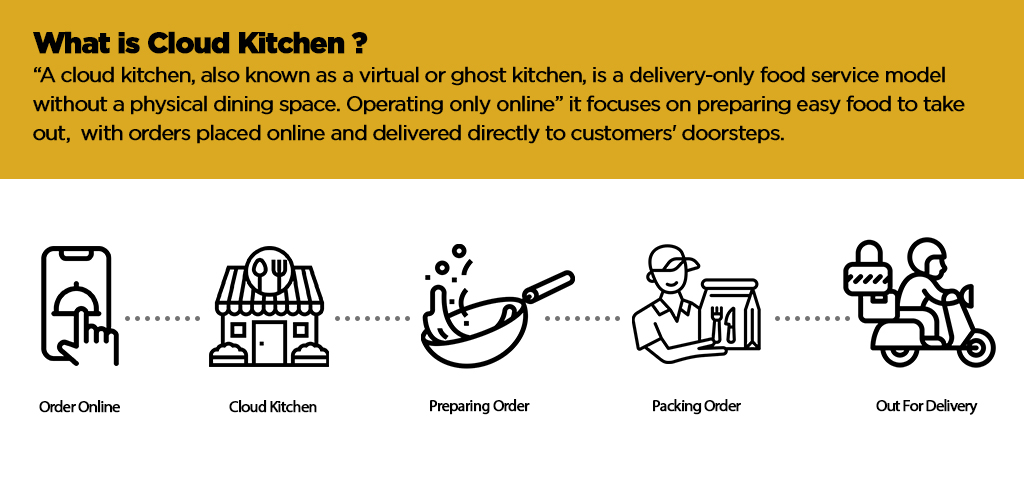
A cloud kitchen receives orders through food delivery platforms, websites, phone calls or other online channels. The kitchen prepares the food, packs it and hands it over for delivery or takeaway. Customers do not visit the kitchen to sit and eat.
A traditional restaurant has a customer-facing outlet. It needs a dining area, seating, service staff and facilities for customers. It can also accept online orders, so it does not have to depend only on walk-in sales.
How Does a Cloud Kitchen Business Model Work?
The cloud kitchen business model is built around online food orders. Customers find the brand on a delivery platform or another ordering channel, select dishes and place an order. Kitchen staff prepare the food and pack it for delivery.
Some operators run one food brand, while others manage multiple brands from the same kitchen. This can help them use common equipment, storage and ingredients more efficiently.
The Rolling Plate is one example of a multi-brand cloud kitchen franchise business. Its website describes franchise formats such as FOFO, FOCO and FOPO, with different levels of owner involvement and operational support. You can understand its cloud kitchen franchise models before comparing a franchise with an independent kitchen.
How Does a Restaurant Business Model Work?
The restaurant business model combines food preparation with customer service. People visit the outlet, choose from the menu, place orders and eat at the premises. Revenue may also come from takeaway orders, catering and online delivery.
A restaurant needs to manage both the kitchen and the customer-facing area. This includes seating, cleanliness, service speed, staff behaviour and the overall dining experience.
Cloud Kitchen vs Restaurant: Key Differences at a Glance
The following comparison explains how the two formats differ in daily operations and business planning.
| Comparison factor | Cloud kitchen | Traditional restaurant |
|---|---|---|
| Initial setup | Usually lower if the kitchen is compact or shared | Usually higher due to dining space and interiors |
| Space requirement | Kitchen, storage and packing area | Kitchen, dining area, washrooms and service space |
| Rent | Can operate in a delivery-friendly, lower-rent location | Often needs a visible commercial location |
| Interiors | Basic functional setup | Furniture, lighting, décor and customer facilities |
| Staff | Cooks, helpers and packing staff | Kitchen team, servers, cleaning staff and manager |
| Customer acquisition | Delivery apps, digital marketing and direct orders | Walk-ins, local visibility, referrals and online orders |
| Order sources | Mainly delivery and takeaway | Dine-in, takeaway and delivery |
| Monthly expenses | Food, rent, staff, packaging, commissions and marketing | Food, rent, salaries, utilities, maintenance and marketing |
| Customer experience | Food quality, packaging and delivery time | Food, service, ambience and overall experience |
| Scalability | Can add brands or delivery locations after testing demand | Expansion usually requires another physical outlet |
| Main challenge | Delivery dependence and online visibility | High fixed costs and maintaining customer footfall |
Neither model wins in every category. A cloud kitchen can reduce property and service expenses, while a restaurant can build stronger local relationships through direct customer interaction.
Cloud Kitchen Investment vs Restaurant Startup Cost
The initial investment depends on the size of the business, city, property condition, menu, equipment and whether you start independently or through a franchise.
A small rented kitchen and a fully equipped multi-brand kitchen will not have the same budget. Similarly, a takeaway restaurant and a full-service restaurant have very different setup requirements.
What Does Cloud Kitchen Investment Include?
Your cloud kitchen investment may include:
- Kitchen rent and security deposit: Payment for a suitable commercial kitchen or shared kitchen space.
- Equipment: Cooking ranges, refrigerators, freezers, preparation tables, mixers and storage racks.
- Exhaust and ventilation: Systems that remove heat, smoke and cooking fumes.
- Preparation and packing areas: Workstations, utensils, shelves and packaging supplies.
- Licences and registrations: Applicable food safety and local business permissions.
- Technology: Billing software, order management systems, internet and printers.
- Raw materials: Initial stock of ingredients, spices and other supplies.
- Staff and training: Salaries, uniforms and food safety training.
- Working capital: Money for rent, stock, salaries, utilities and marketing during the first few months.
If you want to understand the individual cost factors, read this guide to cloud kitchen setup cost in India.
What Does Restaurant Investment in India Include?
The restaurant investment in India can be higher because you need to prepare a space for customers as well as a kitchen.
Common expenses include:
- Commercial property deposit and advance rent.
- Interior work, flooring, lighting and furniture.
- Kitchen equipment, refrigeration and exhaust.
- Dining tables, chairs, service counters and tableware.
- Signage, menu boards and customer facilities.
- Licences and other applicable permissions.
- Kitchen staff, servers, cleaners and management.
- Food inventory, electricity, water and gas.
- Launch marketing and working capital.
A restaurant in a premium market or shopping area may require a much larger budget than a small neighbourhood outlet.
Important: Do not use one fixed investment figure for every business. Treat online cost estimates as starting points. Get property quotations, equipment prices and licence requirements for your own location before finalising your budget.
Cloud Kitchen vs Dine-In Restaurant: Which Has Higher Monthly Expenses?
A cloud kitchen generally has fewer customer-facing expenses, but it still has important recurring costs. A restaurant has more fixed expenses because it maintains a dining area and a larger team.
Cloud Kitchen Monthly Expenses
Typical cloud kitchen monthly expenses include:
- Ingredients and food preparation.
- Kitchen rent and utilities.
- Staff salaries.
- Packaging material.
- Delivery platform commissions and applicable charges.
- Discounts and online promotions.
- Cleaning, maintenance and wastage.
The biggest concern is often the cost of getting orders. If most customers order through third-party platforms, commissions and paid promotions can take a noticeable share of sales.
Restaurant Operating Costs
Restaurant operating costs usually include:
- Food ingredients and beverages.
- Rent and property maintenance.
- Kitchen and service staff salaries.
- Electricity, water, gas and air conditioning.
- Cleaning, repairs and pest control.
- Furniture and equipment maintenance.
- Marketing, offers and customer loyalty programmes.
- Packaging and delivery charges for takeaway orders.
A restaurant can avoid delivery commissions on walk-in sales, but it must earn enough from dine-in customers to cover rent, staff and other fixed expenses.
Cloud Kitchen Profitability vs Restaurant Profitability
A cloud kitchen may require less initial capital, but lower setup cost does not guarantee higher net profit. A restaurant may generate more total sales, but it also carries more expenses.
To compare cloud kitchen profitability with restaurant profitability, understand these basic terms:
- Gross profit: Sales minus the direct cost of food ingredients.
- Contribution margin: Money left after variable expenses such as ingredients, packaging and order-related charges. It helps pay fixed costs.
- Net profit: Money remaining after all business expenses have been paid.
- Break-even: The sales level at which total revenue covers total expenses.
- Return on investment (ROI): A way to compare the profit earned with the money invested.
Illustrative Monthly Profit Comparison
Consider two hypothetical businesses in the same city. The figures below are examples for understanding the calculation, not expected earnings or industry averages.
| Monthly details | Cloud kitchen | Restaurant |
|---|---|---|
| Delivery sales | ₹4,00,000 | ₹1,50,000 |
| Dine-in sales | — | ₹4,00,000 |
| Takeaway sales | ₹50,000 | ₹1,00,000 |
| Total sales | ₹4,50,000 | ₹6,50,000 |
| Food ingredients | ₹1,35,000 | ₹2,08,000 |
| Delivery commissions | ₹90,000 | ₹33,750 |
| Packaging | ₹22,000 | ₹12,000 |
| Rent | ₹35,000 | ₹90,000 |
| Salaries | ₹65,000 | ₹1,20,000 |
| Utilities and maintenance | ₹15,000 | ₹35,000 |
| Marketing and other costs | ₹18,000 | ₹25,000 |
| Illustrative amount left | ₹70,000 | ₹1,26,250 |
In this example, the restaurant earns more money in total because it has dine-in, takeaway and delivery sales. The cloud kitchen needs less space and a smaller team, but delivery commissions affect its earnings.
The restaurant also needs a larger investment to generate its higher sales. Therefore, compare monthly profit with the total investment, not only with revenue.
A cloud kitchen can lose money if order volume stays low, customers use only discounted offers or ratings reduce visibility. A restaurant can struggle if seating remains empty, rent is high or staff costs are not matched by customer demand.
Which Location Is Better for a Cloud Kitchen or Restaurant?
Location should match the way customers buy from your business.
A cloud kitchen does not need a busy high street. It needs a kitchen that can reach enough customers within a practical delivery radius. Check nearby residential societies, offices, colleges, hostels and business areas.
A restaurant needs more visibility and convenient access. Parking, road access, nearby shops, office traffic and evening footfall can influence customer visits.
For example, a delivery-focused kitchen may work near residential demand rather than inside an expensive shopping complex. The Rolling Plate has location-specific pages for cloud kitchen opportunities in Delhi and Noida, which can help readers explore delivery-led business options in these markets.
Before selecting a property, check:
- Local food preferences and popular price ranges.
- Number of competing restaurants and delivery brands.
- Customer spending capacity.
- Delivery time and road access.
- Supplier availability and transport costs.
- Rent compared with expected monthly sales.
- Local permissions for the proposed food business.
Which Model Is Better for Different Types of Entrepreneurs?
The right choice also depends on how involved you want to be in daily operations.
| Entrepreneur profile | Model worth considering | Why |
|---|---|---|
| First-time food business owner | Small cloud kitchen | Fewer customer-facing operations |
| Home chef | Delivery-led kitchen | Can test a focused menu |
| Limited-budget investor | Shared or compact kitchen | Avoids large dining-area expenses |
| Experienced restaurateur | Restaurant or hybrid | Can use existing operating knowledge |
| Owner with a loyal local customer base | Restaurant or hybrid | Can serve dine-in and takeaway customers |
| Entrepreneur planning multiple brands | Multi-brand cloud kitchen | Shared equipment and kitchen resources may support different menus |
A cloud kitchen is not automatically easy to operate. It needs accurate order handling, packaging, food consistency and online customer acquisition. A restaurant needs stronger service management and control over the customer experience.
Can You Combine Both Models? Understanding the Hybrid Food Business Model
Yes. A hybrid food business model combines a physical outlet with delivery and takeaway services.
A restaurant can accept dine-in customers while using its kitchen to fulfil online orders. This creates multiple sales channels from one location, provided the kitchen has enough capacity to manage them.
A cloud kitchen can also test a menu, build a customer base and understand order demand before opening a physical outlet. If customers repeatedly order the same products and local demand supports dine-in, the business can consider expanding.
However, do not add dine-in simply to increase visibility. Seating, service staff, interiors and rent bring new costs. First check whether the expected additional sales can cover them.
Licences and Registrations for Cloud Kitchens and Restaurants in India
Both models must follow applicable food safety and business rules. The exact permissions depend on the location, business activity, premises and scale.
Common requirements may include:
- FSSAI registration or licence: Food businesses must obtain the applicable approval based on their activity and eligibility.
- GST registration: Required where applicable under current GST rules. Food delivery through platforms can involve specific tax provisions, so check the rules for your business structure.
- Local trade licence: Municipal permissions may apply to commercial food outlets.
- Shop and Establishment registration: Check the relevant state requirements.
- Fire safety approval: May be required depending on the building, kitchen equipment and local rules.
- Other local permissions: Signage, waste disposal, commercial use of premises and vending permissions may apply.
A restaurant may have additional building and customer-facility requirements. A cloud kitchen must still meet food safety, hygiene, ventilation and premises requirements. Verify the latest rules with the relevant authorities before starting.
How to Choose and Start the Right Food Business
Use the following steps before spending money on equipment or signing a rental agreement.
- Research local demand: Speak with potential customers and study what they order, how often they buy and what they are willing to pay.
- Choose a food concept: Select a menu that suits either delivery, dine-in or both. Check whether the food travels well.
- Study competitors: Compare their prices, portion sizes, delivery time, customer feedback and popular products.
- Prepare an investment plan: Include setup expenses, deposits, licences, equipment and working capital.
- Select the location: Choose a delivery-friendly area for a cloud kitchen or a visible, accessible property for a restaurant.
- Calculate dish-level costs: Include ingredients, packaging, fuel, labour and platform charges where applicable.
- Arrange licences and suppliers: Complete registrations and confirm regular supply of quality ingredients.
- Set up the kitchen: Plan storage, preparation, cooking, cleaning and packing areas.
- Train staff: Set clear procedures for food quality, hygiene, order handling and customer service.
- Launch and track performance: Start with a controlled menu and review order volume, average order value, food cost, wastage, complaints and net profit every month.
For more planning help, explore The Rolling Plate’s guide to starting a cloud kitchens business and its food business information.
Common Mistakes to Avoid Before Opening
- Choosing a model only because it costs less: Check whether local customers actually want the food you plan to sell.
- Ignoring delivery charges: Include commissions, packaging and discounts when calculating online order profit.
- Renting too much space: Start with the capacity you need instead of paying for unused areas.
- Creating an oversized menu: Too many ingredients increase stock costs, preparation time and wastage.
- Underestimating working capital: Keep money aside for operating expenses during the early months.
- Depending on one sales channel: Build direct customer relationships where practical and permitted.
- Expanding before the model works: Prove demand, service quality and unit economics at one location first.
- Not checking franchise terms: Understand investment, revenue sharing, operational duties, marketing costs and exit conditions before signing.
Make Your First Food Business Decision With Clear Numbers
Choose a cloud kitchen if you want to focus on delivery, test a food concept with a smaller customer-facing setup or explore multiple brands from one kitchen. Consider a restaurant if your concept depends on dine-in experience, local footfall and direct customer interaction. If you want both, a hybrid model may be suitable once you understand the costs and demand for each channel.
The Rolling Plate provides cloud kitchen franchise options with different levels of owner involvement, including FOFO, FOCO and FOPO formats. If you are comparing these options with an independent kitchen or a traditional restaurant, review the available cloud kitchen models and frequently asked questions first. You can also Contact us to discuss the available franchise formats and understand which option may match your business plans.
Frequently Asked Questions
1. Which is better, a cloud kitchen or a restaurant?
A cloud kitchen may suit entrepreneurs who want to focus on delivery with less customer-facing space. A restaurant may suit businesses that depend on dine-in customers and local visibility. The better option depends on budget, demand and operating skills.
2. Is a cloud kitchen cheaper to start than a restaurant?
Usually, yes. A cloud kitchen does not need dining furniture, customer seating or expensive front-of-house interiors. However, equipment, ventilation, rent deposits, licences and working capital still need to be included.
3. Which business is more profitable: a cloud kitchen or a restaurant?
Neither is always more profitable. A cloud kitchen may have lower fixed costs, while a restaurant can earn through dine-in, takeaway and delivery. Compare net profit after all expenses rather than looking only at sales.
4. How much space is required for a cloud kitchen?
It depends on the menu, equipment, storage and expected order volume. A compact operation needs enough room for safe food preparation, cooking, washing, storage and packing. Check local premises and food safety requirements before renting.
5. What are the monthly expenses of a cloud kitchen?
Common expenses include ingredients, rent, salaries, packaging, utilities, delivery commissions, marketing, cleaning and maintenance. The exact amount changes with order volume and the way the kitchen operates.
6. Do cloud kitchens have to pay delivery platform commissions?
Cloud kitchens using third-party delivery platforms may have to pay commissions and other applicable charges under their agreements. These costs should be included when setting menu prices and calculating profit.
7. Do cloud kitchens and restaurants need the same licences?
Both need the applicable FSSAI approval and may need GST registration and local permissions. Other requirements can differ based on the premises, business activity and local rules.
8. Is a cloud kitchen good for beginners?
It can be a suitable starting point for someone who understands food preparation, delivery operations and online customer acquisition. Beginners should start with a focused menu and enough working capital rather than assuming the model runs itself.
9. Can a restaurant operate as a cloud kitchen too?
A restaurant can accept delivery orders from its existing kitchen. It can function as a hybrid business, serving dine-in customers as well as takeaway and delivery orders, if the kitchen has enough capacity.
10. How do I choose between a cloud kitchen and a restaurant?
Compare your budget, menu, customer demand, location, rent, staffing needs and expected order channels. Prepare a monthly sales and expense estimate for both models, then choose the one that can reach break-even with manageable risk.

Enquire Now
Recent Post



Other Blogs
Discover our latest news
and updates now.
Is the Food Business a Good Investment Opportunity in India?
November 06, 2026
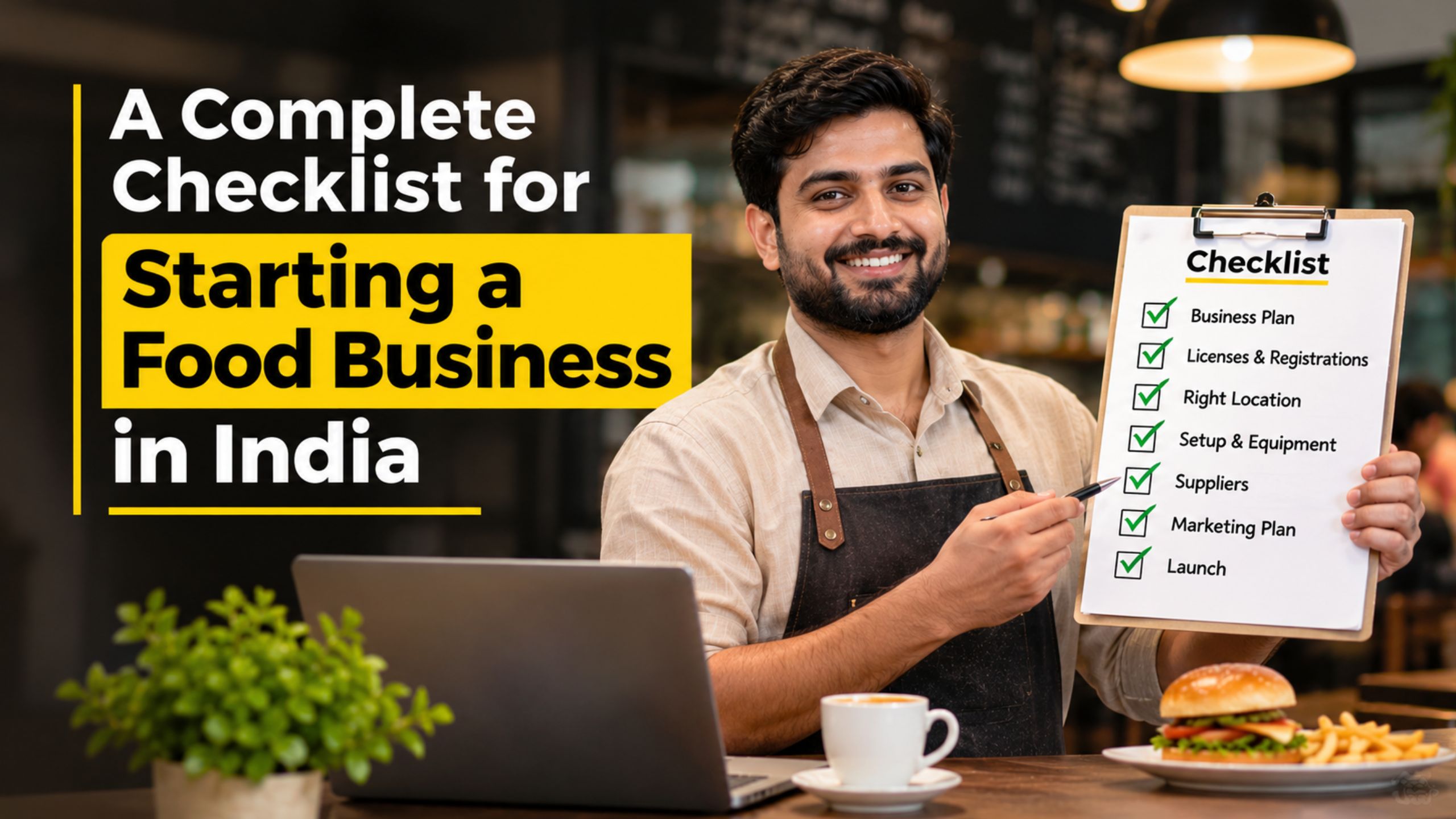
A Complete Checklist for Starting a Food Business in India
November 05, 2026
Which Food Businesses Are Most Profitable?
November 02, 2026
Low Cost Food Franchise in India for First-Time Business Owners
October 21, 2026
Cafe Franchise in India: Investment, Space, Fees & How to Start
October 19, 2026